Following feedback from the crit, I removed Photoshop entirely and focused on working only with the scanner and printer. This shift towards analogue processes allowed the project to develop through physical manipulation rather than digital editing.
Instead of adjusting the image digitally, I began manipulating the CD cover directly on the scanner bed. By rotating the image, moving it during scanning, and experimenting with positioning, I could produce distortions that were generated entirely through the scanning process.
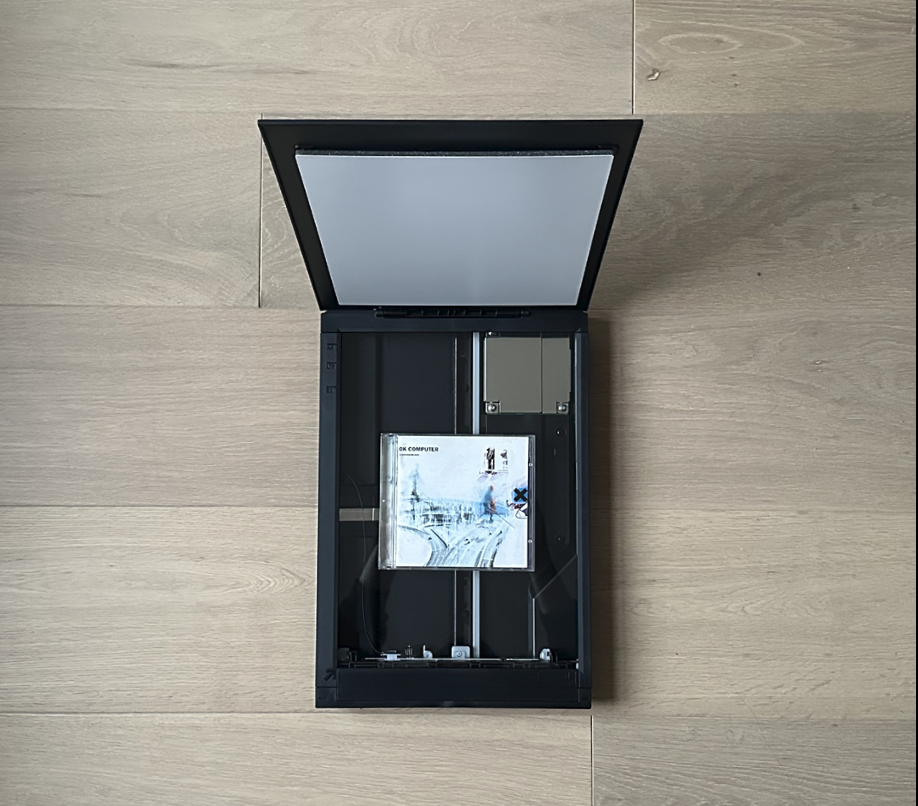
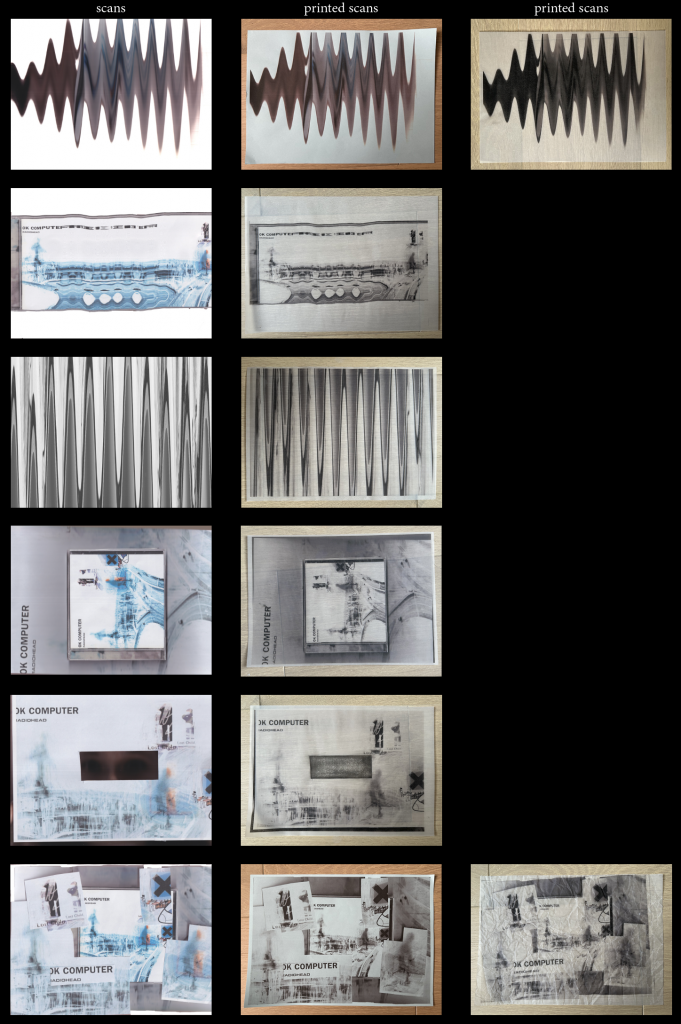
These distorted scans were then printed on a range of paper types, including coloured paper, lined paper, and tracing paper. I also experimented with both colour and black and white printing, and with different resolutions such as 72dpi and 300dpi to see how speed and compression would affect the image.
Over time, I found that the most visually successful results came from working in black and white on tracing paper at 72dpi. Removing colour strengthened the graphic qualities of the image and allowed the distortions created by the scanner to become more prominent.
Examples;
At this point I began thinking about the project in relation to Raymond Queneau’s Exercises in Style. In the book, the same simple story is retold multiple times under different stylistic constraints. The narrative itself does not change, but the method of telling it does.
Similarly, in my process the image remains constant while variation emerges through the system that produces it. Each scan introduces new distortions, compressions, or misalignments, gradually shifting the image further away from the original.
This made me reflect on authorship in a new way. If the machine is responsible for many of the transformations, where does authorship actually lie? Is it in the original image, in the designer’s decisions, or in the system that produces the variations?
That’s all for week 2…
Leave a Reply