Draft 1:
While copying OK Computer through a print–scan process, I became increasingly aware of how little control I had over the image. Each time I printed and rescanned, the image shifted in ways I could not fully predict. Colours intensified (especially the blues), details disappeared, and layers merged unexpectedly. Rather than feeling frustrating, this loss of control became the most engaging part of the process.
Working without undo forced me to accept each decision as permanent. Instead of correcting mistakes, I had to respond to them. This changed my relationship to making: the process felt less about perfecting an outcome and more about staying present and adapting to what the image became. The copy slowly moved away from precision and towards something more instinctive and personal. This raised questions about control and authorship in design. How much control do we need in order to feel confident in our work? What happens when tools resist us instead of obeying us? Can letting go of precision create a different kind of honesty within graphic practice? How does that translate in creating commercial work for brands?
To explore this further, I propose a studio experiment focused on controlled loss of control. Using the same base image, I want to repeat a print–scan cycle while limiting my ability to intervene, observing how the image evolves when decision-making is reduced and the process itself begins to lead.
Draft 2;
In Exercises in Style, Queneau (1998) offers a useful framework through which to reconsider my project. In the book, the author retells the same short, banal event ninety-nine times, each version constrained by a different stylistic rule. What changes is not the content, but the method of telling. Meaning emerges not from invention, but from repetition, variation, and constraint. This approach closely mirrors the direction my practice has taken. While my initial copy of OK Computer explored degradation through a print–scan loop, my process has since become more raw and materially driven. I removed digital design tools such as Photoshop entirely, working only with a printer, scanner, paper, and scissors. The act of making became physical: cutting, layering, reprinting, rescanning. Each iteration was not a refinement toward a better image, but a re-statement of the same source through altered conditions.
Like Queneau, I am working with a fixed starting point. The image does not change, but the system around it does. Each scan introduces distortion, compression, shift, or accidental alignment. The constraints are not pre-written rules, but mechanical and material ones; paper quality and style, density, colour, scanner glare. Over time, these limitations begin to function like Queneau’s stylistic exercises, shaping outcomes while resisting total authorial control.This comparison reframes my earlier questions about control and authorship. In Exercises in Style, Queneau remains present as the orchestrator, yet the individuality of each version is produced by the constraint itself. Similarly, in my process, authorship feels distributed between myself and the machine. The printer and scanner are not neutral tools executing instructions, but active participants that introduce their own logic and errors. What becomes increasingly clear is that variation itself is the content. The project is no longer about copying OK Computer faithfully, nor about producing a singular final image. Instead, it operates through accumulation. Meaning appears across multiple outcomes rather than within one resolved piece. This aligns with a mode of iteration where the process, rather than the result, becomes the primary output.
Viewing my work through Queneau’s methodology clarifies the direction of my studio experiment. Rather than aiming for aesthetic improvement, the focus shifts toward systematic difference: repeating the same act while allowing form to mutate. The act of scanning becomes a form of writing, where each pass produces a new sentence composed by friction, error, and constraint. This perspective strengthens my inquiry into graphic communication by questioning where expression truly sits. Is it located in the image itself, in the system that produces it, or in the accumulation of versions over time? By embracing analogue iteration and limited control, the work moves away from design as optimisation and toward design as exploration, where meaning is not designed in advance, but discovered through repetition and interpretation.
Draft 3;
This project began by copying the album artwork for OK Computer by Radiohead (Donwood & York, 1997). The artwork was chosen for its layered, unstable visual language and its association with digital distortion and technological anxiety. Rather than aiming for faithful reproduction, I approached the album cover as material to be reworked through my own process of making, allowing the act of copying to become a site of transformation rather than preservation.
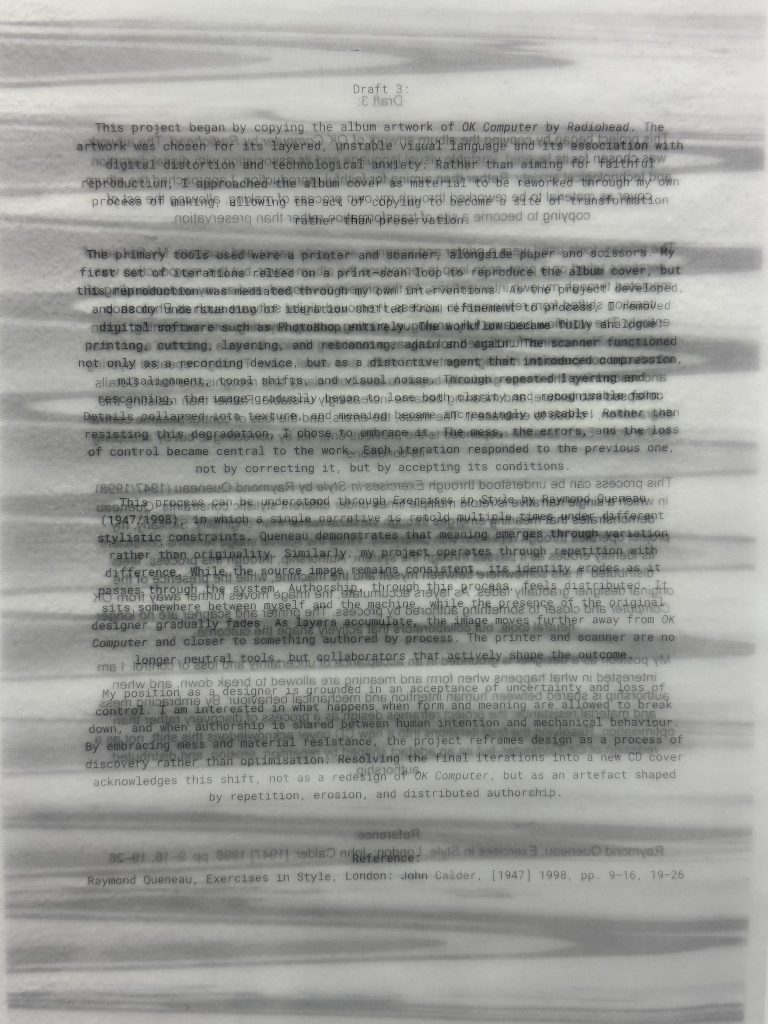
The primary tools used were a printer and scanner, alongside paper and scissors. My first set of iterations relied on a print–scan loop to reproduce the album cover, but this reproduction was mediated through my own interventions. As the project developed, and as my understanding of iteration shifted from refinement to process, I removed digital software such as Photoshop entirely. The workflow became fully analogue: printing, cutting, layering, and rescanning, again and again. The scanner functioned not only as a recording device, but as a distortive agent that introduced compression, misalignment, tonal shifts, and visual noise. Through repeated layering and rescanning, the image gradually began to lose both clarity and recognisable form. Details collapsed into texture, and meaning became increasingly unstable. Rather than resisting this degradation, I chose to embrace it. The mess, the errors, and the loss of control became central to the work. Each iteration responded to the previous one, not by correcting it, but by accepting its conditions.
This process can be understood through Exercises in Style by Queneau (1998), in which a single narrative is retold multiple times under different stylistic constraints. The author demonstrates that meaning emerges through variation rather than originality. Similarly, my project operates through repetition with difference. While the source image remains consistent, its identity erodes as it passes through the system. Authorship, through this process, feels distributed. It sits somewhere between myself and the machine, while the presence of the original designer gradually fades. As layers accumulate, the image moves further away from OK Computer and closer to something authored by process. The printer and scanner are no longer neutral tools, but collaborators that actively shape the outcome. My position as a designer is grounded in an acceptance of uncertainty and loss of control. I am interested in what happens when form and meaning are allowed to break down, and when authorship is shared between human intention and mechanical behaviour. By embracing mess and material resistance, the project reframes design as a process of discovery rather than optimisation. Resolving the final iterations into a new CD cover acknowledges this shift, not as a redesign of OK Computer, but as an artefact shaped by repetition, erosion, and distributed authorship.
Blending my enquiry for draft 3;
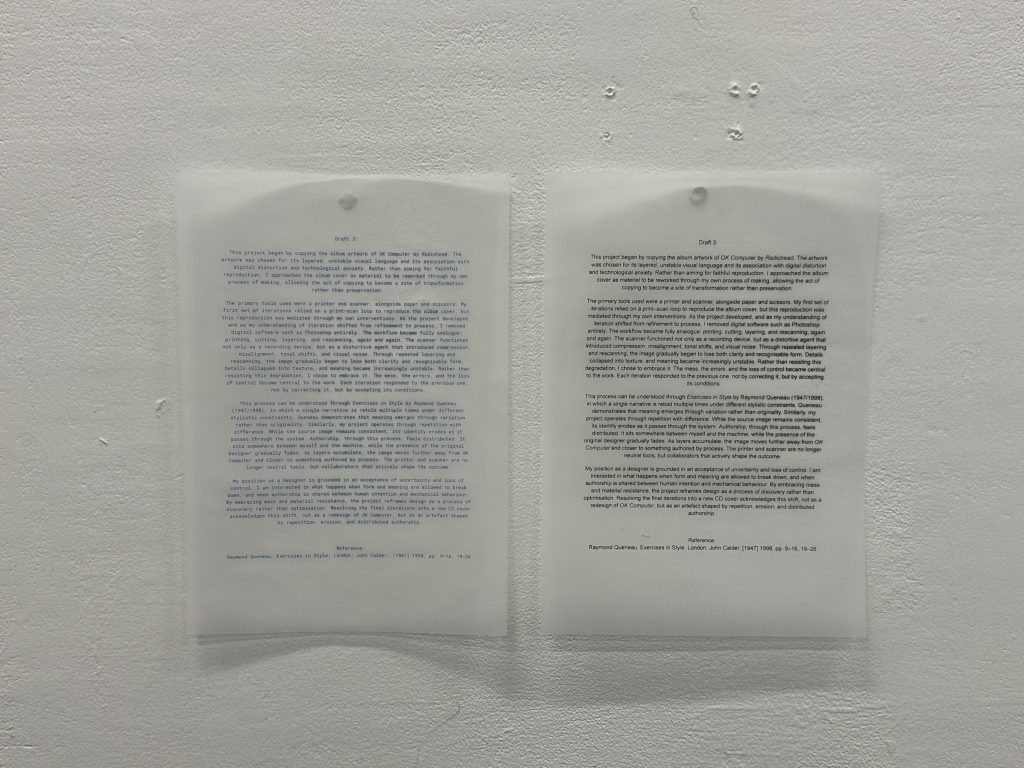
Initial print on tracing paper, blue evoking the cover of OK Computer.
Moving on, layering my print with previous prints, using the same print scan process.
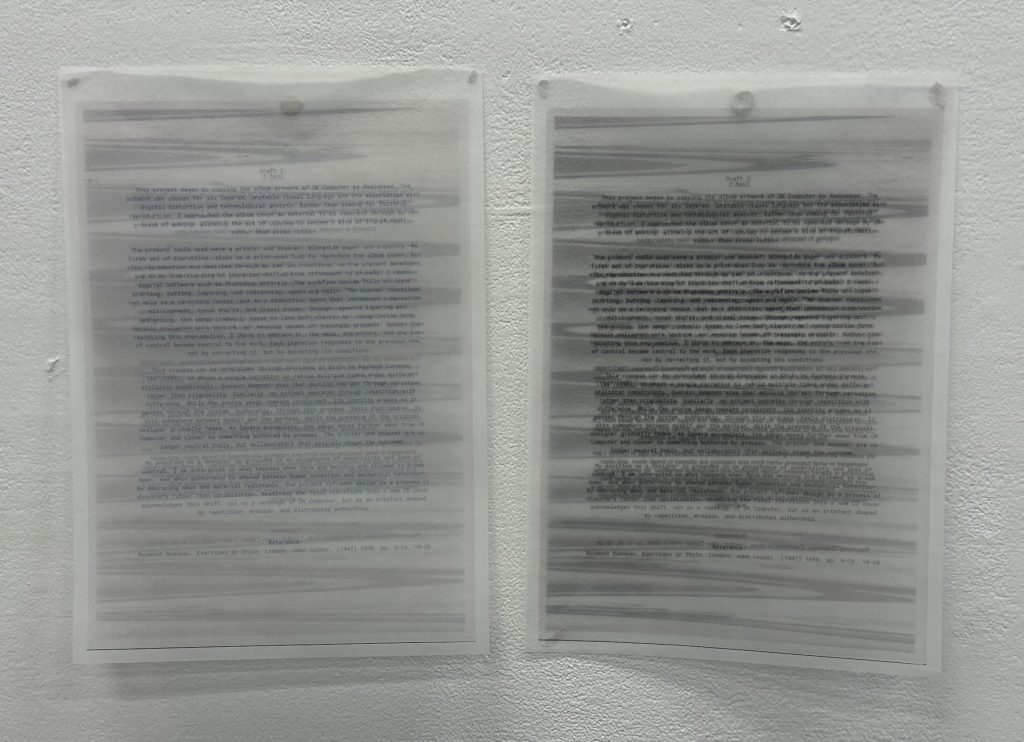
Final print;
References;
Donwood, S. & Yorke, T., 1997. Album artwork for OK Computer. Radiohead.
Queneau, R., 1998. Exercises in Style. London: John Calder. (Originally published 1947)
Leave a Reply